By Paul Fimbres
Leader in matching latest technology with latest projects related to long term Space Mining and Manufacturing , Integration Tech, Inventor, Philosophical think tank, Fabricator, Design Engineer, Robotics Integration
Presents the first article in an exciting series titled: « You don’t have to be a rocket scientist to figure this out. »
Cislunar-to-Martian Industrialization Infrastructure: A Unified Paradigm for In-Situ Resource Utilization (ISRU), Co-Generation Nuclear Foundries, and Biomechanical Automata Fleet Operations
Author: CILEC Engineering Consortium
Lead System Architect: Jan Perera Rodriguez
Staging Facility: Phoenix Business Park, The Compound, Palm Bay, Florida, USA
Affiliated Frameworks: NASA NextSTEP-3 Appendix A (Release 26-072) & Florida Semiconductor Engine Cluster (NSF-2315320)
Abstract
This paper presents a complete, closed-loop industrial infrastructure model designed to transition space commerce from a high-mass, Earth-dependent architecture to a state of self-replicating autonomous sovereignty. By anchoring corporate finances in terrestrial, multi-gigawatt Thorium Molten Salt Reactors (TMSR) configured for Zero Liquid Discharge (ZLD) municipal desalination and secure artificial intelligence (AI) compute grids, the upfront capitalization costs of deep-space heavy machinery are completely offset.
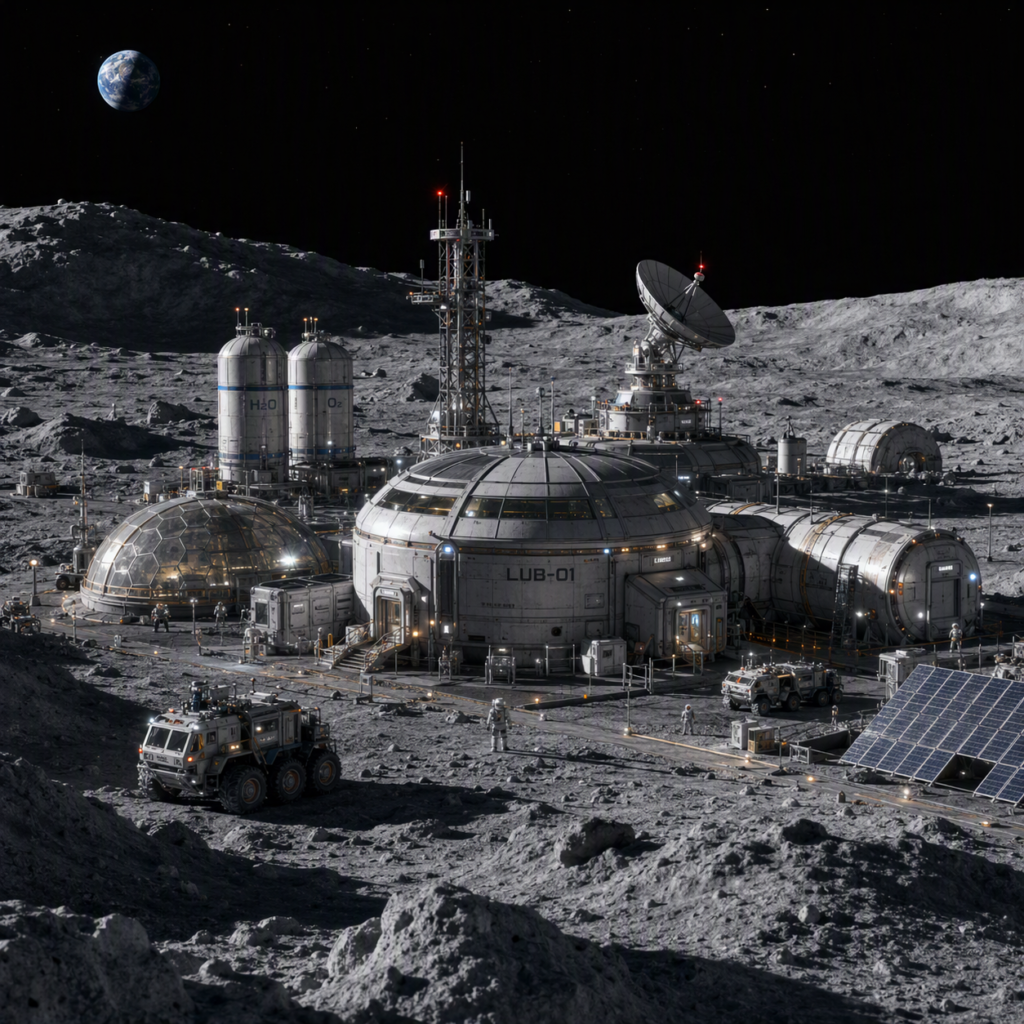
We detail the mechanical, metallurgical, and structural workflows of the Lunar Utility Base (LUB) chassis and its apex biomechanical mining configuration, the LOBSTERobot. This platform morphs dynamically across variations in size, shape, and mobility regimes (including a specialized active walking stilt intervention) to eliminate standard immobilization vulnerabilities in jagged planetary media.
Finally, this paper details the operational blueprint of mobile Solar System Transport Factories (SSTF). These large, artificial-gravity transport architectures harvest asteroid bodies and planetary permafrost, processing unrefined ores into structural elements while in interplanetary transit, thereby establishing a continuous material production line across the cislunar, Martian, and deep-space corridors.
1. Introduction & The Constitutional Adaptability Mandate
Modern aerospace logistics are critically bottlenecked by the extreme financial and energetic tax of escaping Earth’s gravity well. Historically, space exploration has relied on bespoke, single-mission vehicles shipped entirely from the terrestrial surface, yielding astronomical upfront Capital Expenditures (CapEx) and rigid operational pipelines. To dismantle this limiting paradigm, the Cislunar Infrastructure Logistics & Energy Corporation (CILEC) establishes a unified, multi-planetary utility framework.
Crucially, the operational blueprints, financial allocations, and technical bylaws of this enterprise are ordained under a Living Constitutional Charter. Modeled precisely on the adaptive structural mechanics of the United States Constitution, this foundational document is explicitly designed to expand and change across generational horizons. Recognizing that rapid advancements in automated machine intelligence, localized metallurgy, and high-cadence launch architectures will continuously shift industrial limits, this charter is not a static mandate. The governing board retains a decoupled, super-voting constitutional amendment authority to alter operational clauses as technology advances, keeping the baseline infrastructure optimized at the absolute frontier of cislunar and deep-space capability.
2. Phase 1: The Terrestrial Proving Ground & Space Coast Staging
To fully eliminate the technical developmental risks inherent to space-staged deployment, the entire infrastructure loop is initially proven and operated at a full-scale terrestrial twin facility.
2.1 Geographic Siting & The Palm Bay Compound Infrastructure
The core manufacturing, testing, and system integration lines are staged within The Compound at the Phoenix Business Park along J.A. Bombardier Boulevard in southwest Palm Bay, Florida. This location takes direct advantage of the $3.5 Million Florida Job Growth Grant Fund, which opened up heavy industrial wastewater force-mains and lifting stations to support high-tech space, defense, and advanced semiconductor manufacturing lines.
The physical hangar is outfitted with a 10-ton minimum overhead crane running along the primary structural columns to handle base mobility chassis rigging and internal propellant tank alignment. Outside the high-bays, a 20-ton heavy industrial gantry system manages full vertical vehicle integration and loads completed modules directly into transport capsules.
To pass the stringent safety and quality benchmarks demanded by corporate underwriters, the facility enforces a rigid 5S Foreign Object Debris (FOD) Prevention Audit Loop. Tools are housed on laser-etched shadow boards matching exact physical cutouts. Every tool handle is embedded with a passive radio-frequency identification (RFID) tracking chip synced to the active technician’s security profile. Prior to sealing any high-pressure propellant tank, reactor casing, or rover compartment, automated tool-room sensors scan the deck. If a single socket or instrument remains unaccounted for, the assembly line locks down automatically, eliminating mechanical failure vectors caused by trapped loose items.
2.2 Co-Generation Thorium Architecture & Grid Off-Take
The terrestrial proving ground is anchored by a co-located, multi-unit 2.5 GW Thorium Molten Salt Reactor (MSR) plant. This setup splits its energy output across two distinct commercial pipelines to establish an immediate financial equilibrium:
- Commercial Off-Take (1.5 GW Core): Delivers clean, off-grid baseline power directly to high-density, secure AI data center pods via long-term Power Purchase Agreements (PPAs) signed at a baseline tariff of $0.0120 per kWh, generating a secure, non-dilutive inflow of $873.81 Million annually.
- Industrial Off-Take (1.0 GW Core): Utilizes the reactor’s high-temperature loop heat (
700∘C700 raised to the composed with power C
700∘C
to
900∘C900 raised to the composed with power C
900∘C
) to drive coastal thermal desalination lines. By boiling seawater and routing the hypersaline byproduct through brute-force crystallization lines, the facility achieves Zero Liquid Discharge (ZLD). This eliminates the toxic marine dead zones caused by traditional brine dumping, producing clean municipal water for water-stressed regions while drying waste streams into solid, marketable industrial carbonate minerals.
Purified fresh water from this co-generation loop is dynamically routed into automated electrolytic lines to manufacture cryogenic liquid hydrogen and liquid oxygen rocket fuels. By loading these propellants into extra-large storage tanks built into next-generation fully reusable launch vehicles (such as Stoke Space’s regeneratively cooled metallic upper-stage structures), the enterprise maximizes launch mass weights at liftoff, sending bulk water and fuel into orbital storage corridors to serve as an available cislunar resource reserve.
3. Phase 2: The Lunar Industrialization Regime & Biomechanical Automata
Upon proving the fluid loops and automated mechanisms stateside, the initial hardware manifest is launched along low-energy ballistic transfer paths to drop mass onto target lunar polar coordinates.
3.1 The Universal LUB Chassis & Universal Interface Matrix (UIM)
The baseline surface mobility asset is the Lunar Utility Base (LUB), a standardized, 6-wheeled modular chassis featuring an independent drive and a Mars-rover-style rocker-bogie suspension. Every wheel hub features an autonomous, high-torque electric motor with 360-degree independent steering, allowing for tight pivot turns and cross-crater crabbing.
The primary interface of the LUB is the Universal Interface Matrix (UIM) an armored quick-connect docking plate mounted flush along the top spine of the chassis. When a functional tool attachment mechanically engages, the UIM activates three layers of sealed utility pass-throughs:
- Electric Link: Dual-bus high-voltage DC paths to drive heavy cutting motors paired with low-voltage lines for localized sensor logic.
- Fluidic & Hydraulic Link: Employs Space Ocean Corp’s automatic zero-leak space liquid couplings and Tetraodon interconnects. These lines route low-vapor-pressure synthetic oils that resist freezing or boiling in space vacuum, driving heavy actuators and circulating thermal management fluid across the vehicle.
- Pneumatic & Vacuum Link: High-pressure compressed nitrogen lines to operate pneumatic drills paired with continuous vacuum suction conduits to draw loose material.
3.2 The LOBSTORobot Biomechanical Architecture
To execute high-volume surface mining, the LUB chassis docks with the apex harvester configuration: the LOBSTERobot, an autonomous machine designed explicitly around the mechanical thesis created by innovator Jan Perera Rodriguez:
“Our LOBSTERobot is different than the others (95% are expensive toys), can change size, shape, and also walk. That’s why it can’t get stuck.”
[<= REVERSE MOVEMENT MINING PATH <=]
( )=================( ) <── Primary Grip-Claws Clear Surface Hazards
\\ _____________ //
\\ / \ //
─┤ Armored Carapace ├─ <── Sliders Adjust Size (Width-Reduction Matrix)
/| NDT Carousel |\\
/ |_______________| \\ <── Sapphire UAI Swaps Sensors / Tools in 12s
│ │ │ │ │ │ │ │ <── 4x Pairs of Lateral Limbs Enter Walking Mode
\==/ \====/ \====/ \==/ <── Rocker-Bogie Tracks Ride Flush
\_ (O) (O) _/ <── Counter-Rotating Sweeper Brushes & Skids
Rodriguez’s biomechanical framework introduces true physical adaptability to survive the erratic, non-standard geologies of space bodies:
- Changing Size: The LOBSTERobot’s exoskeleton carapace consists of overlapping metal scale plates mounted on automated hydraulic sliders. When mapping narrow ravines or passing through pressurized hangar locks, the chassis contracts its width. When operating in wide maria fields, it expands the shell to maximize its sifting sweep zone.
- Changing Shape: The universal mobility base scales its layout dynamically based on project status. By adjusting its internal frame extension links, the same primary chassis transforms from an open half-body exploration flatbed truck to a massive, stretched full-body carrier configured to support a pressurized human habitation core.
- Walking Mode Intercept: If the tires encounter fine, highly abrasive, electrostatically charged dust fields or pocketed fissures where standard wheels spin and high-center, the rover switches from driving to walking. Four pairs of multi-jointed lateral limbs deploy from side recesses. Equipped with high-friction micro-pads, these legs walk across the raw terrain or anchor into bedrock, acting as mechanical stilts that lift the primary LUB chassis completely out of the obstruction and move it forward until the wheels regain solid footing, ensuring the rover can never get permanently stuck.
3.3 Material Sifting & The Closed-Loop Foundry Link
The LOBSTERobot operates in a continuous Reverse-Harvest Sequence. Driving backward into unmined zones, its forward-facing hydraulic Grip-Claws (the left claw acts as a high-torque crusher; the right acts as a precise tungsten-carbide cutter) clear surface hazards and lift cargo containers. Symmetrically spaced side limbs drop down to execute real-time subterranean mapping via Laser-Induced Breakdown Spectroscopy (LIBS) and Ground Penetrating Radar (GPR).
At the trailing edge, two counter-rotating vertical brushes sweep raw regolith upward into an enclosed conveyor belt, while titanium-reinforced side skids maintain pressurized ground contact to act as a dust skirt. The material is force-fed into an internal Three-Stage High-Frequency Sifting Hopper:
- Stage 1 (
>25
mm
): Titanium-carbide screens shake back and forth via a high-frequency hydraulic vibrator to scalp away and eject large, unprocessable boulders out a rear chute.
- Stage 2 (
5
mm
to
25
mm
): Woven mesh screens separate the prime, mineral-rich ore chunks, routing them into the primary holding compartment.
- Stage 3 (
<5
mm
): Microscopic regolith dust falls into a lower floor chamber where low-pressure nitrogen gas fluidizes the particles into a vacuum line, trapping the dust against an electrostatic collector plate to pack it into dense bricks reserved exclusively for 3D-printing habitat walls.
When the mid-grade ore hopper reaches 90% capacity, an autonomous LUB Haul Truck docks with the loader. Electromagnetic rings lock the vehicles together to form a dust-free seal, and an internal auger drives the clean, sifted ore into a titanium tipper bed. The truck travels to the Intake Vestibule of the Lunar Thorium MSR Plant. The bed tilts to 90 degrees while internal ultrasonic transducers break the static cling of the regolith, sliding it into the extraction hatch.
The plant pumps superheated molten fluoride salt (
850∘C850 raised to the composed with power C
850∘C
to
1100∘C1100 raised to the composed with power C
1100∘C
) directly into a rotating centrifugal induction crucible. Volatile oxygen, nitrogen, and Helium-3 gases boil off first to replenish spaceplane propellants and base life support. The remaining material melts into a molten silicate slurry, which is continuously extruded into dense cast-basalt structural beams or atomized into pure titanium and aluminum powders for electron-beam 3D printing. This allows the entire fleet to self-replicate and build permanent landing pad infrastructure natively on the Moon.
4. Phase 3: The Martian Migration Regime & Environmental Transitions
Upon achieving autonomous material sovereignty on the Moon, operations scale into the Martian theater under an aggressive 5-Year Infrastructure Sprint. This transition requires modifying our lunar designs to handle a completely different environment, including aerodynamic dust storms and a carbon-dioxide-rich atmosphere.
[ Phase 2: Lunar Sovereign Base ] ───( 5-Year Scaling Window )───► [ Phase 3: Martian Base ]
– Vacuum Operational Architecture – Aerodynamic Dust Storm Shielding
– KREEP Regolith Sifting Chutes – High-Density Iron Sand Sifting
– Geothermal Night Rejection – Sabatier Methane Fuel Production
4.1 Glacial Core Trenching & The Sabatier Fuel Loop
On Mars, the LOBSTERobot’s lateral limbs swap out sifting hoppers for high-torque, diamond-tipped percussive core drills. The rovers descend steep, frozen crater slopes to extract pristine water-ice cores from shallow subsurface glacial sheets.
The recovered ice is transferred to an internal chemical refinery loop where it is melted via secondary thermal lines from our modular Thorium reactors. The liquid water is combined with atmospheric carbon dioxide inside an automated Sabatier Reactor Matrix, running continuous catalytic methanation to manufacture pure methane (
CH4CH sub 4
CH4
) and liquid oxygen (
LOXLOX
LOX
) propellants right on the surface, establishing an independent fuel pipeline to support return spaceplanes and ascent vehicles.
4.2 Magnetic Iron Sand Metallurgy
Unlike the anorthite-rich lunar highlands, the Martian surface is dense with ferric oxides. The LOBSTERobot’s ground-contact plates are retrofitted with powerful, high-intensity electromagnetic arrays. As the vehicle tracks across the Martian plains, these magnets pull highly magnetic iron sands directly out of the loose soil, completely bypassing traditional mining excavation trenches. This pure iron stream is directed into a high-energy plasma-arc atomization loop powered by the modular nuclear grid, outputting fine iron powder feedstock. This material is used by our electron-beam additive manufacturing bays to 3D-print high-strength habitat pressure shells and structural machinery spares on-site, cutting out Earth-to-Mars supply chains.
5. Unified Space-Based Manufacturing Architecture: Solar System Transport Factories (SSTF)
The final stage of corporate expansion transitions our assets from fixed planetary outposts into mobile, self-replicating space factories: Solar System Transport Factories (SSTF). These giant production ships process materials and manufacture products while traveling along interplanetary trajectories, creating a continuous material supply chain across deep-space corridors.
[ THE SSTF MASTER FLEET HUB ]
│
┌──────────────────────────────┬───────────────┴───────────────┬──────────────────────────────┐
▼ ▼ ▼ ▼
[ 5.1 ERTF ] [ 5.2 LRTF ] [ 5.3 MRTV ] [ 5.4 LTF ]
– Extreme Range Matrix – Long Range Mother – Mid Range Logistics – Local Shuttle Cargo
– Deep Asteroid Belt – Interplanetary Transit – Moon-to-Mars Transfer – Orbital Delivery
– 1.5-Mile Rotor Core – Automated Foundry Deck – Cryogenic Propellants – Tether-Net Tugs
5.1 ERTF (Extreme Range Transport Factories)
The largest vessels in the fleet are the Extreme Range Transport Factories (ERTF), deployed within the Main Asteroid Belt and Jupiter Trojan clusters. These ships feature a massive 1.5-mile radius (2,414-meter) dual-rotor hull configured to spin continuously at 0.61 RPM. This rotation creates an artificial 1-g floor environment at the outer rim, eliminating the bone density loss and systemic space anemia that threaten human crews during long-term deep-space operations.
Conversely, the ship’s central axis houses a zero-gravity hub optimized for Variable-Gravity Molecular Engineering. By spinning specialized induction manufacturing decks at precise, constant speeds, technicians process advanced alloys, single-crystal semiconductors, and diamond-packed composite sheets that cannot form under the gravitational constraints of a planetary surface.
The outer hull of the ERTF is encased in thick, double-walled modular tanks filled with fresh and salt water. This high-hydrogen liquid matrix serves as a defensive shield against cosmic rays and solar flares, while hosting living microalgae bioreactors (Chlorella) and sustainable marine life to create a closed-loop bioregenerative life support system (BLSS). To stabilize the vessel, internal baffles force the water to spin at the exact same velocity as the hull, converting the liquid layer into a massive kinetic flywheel. When heavy mining equipment or processed ore is moved inside the ship, internal pneumatic bladders inflate or deflate dynamically, shifting water mass to keep the center of gravity locked onto the central axis, preventing balancing wobbles.
5.2 LRTF (Long Range Transport Factories)
Operating across the interplanetary transit corridors between High Earth Orbit (HEO), Lunar Lagrange points, and Mars, the Long Range Transport Factories (LRTF) feature a 397.5-meter radius (795-meter total diameter) dual-rotor hull spinning at 1.5 RPM to maintain a 1-g floor environment. The LRTF acts as a long-range mother ship. It carries a complete fleet of LOBSTORobot rovers inside its lower bays, housing automated processing foundries within its central hub. While traveling between planets, the automated factory processes unrefined asteroid ores, continuously printing prebuilt modular habitats, structural I-beams, and landing pad components, meaning the cargo is fully manufactured, certified, and ready for deployment before the ship ever touches down at the next settlement.
5.3 MRTV (Mid Range Transport Factories)
The Mid Range Transport Factories (MRTV) are highly maneuverable logistics vessels optimized to operate within cislunar space, Earth-Moon L1/L2 lanes, and Martian orbital transfer vectors. These ships function as the primary transport link, shuttling atomized metal powders, processed structural elements, and cryogenic propellants between the planetary surface hubs and the larger interplanetary mother ships.
5.4 LTF (Local Transport Factories)
Operating inside high-density orbital constellation corridors, the Local Transport Factories (LTF) are agile orbital variants of the LOBSTORobot space tug fleet. They are outfitted with retractable carbon-composite arms and tethered webbed Kevlar nets with neodymium magnetic weights to safely match, de-spin, and capture uncooperative, tumbling nuclear-payload satellites. The LTF strips away non-radioactive structural frames to feed the OMPH shredders, while isolating decaying uranium and plutonium components inside lead-lithium containment casks. These radioactive materials are down-railed to our Thorium MSR plants to serve as high-flux neutron ignition seeds or manufactured into diamond-shielded, 87-year half-life alpha-voltaic batteries to power our long-range surface rovers, transforming an orbital hazard into a valuable industrial asset.
6. Comprehensive Work Breakdown Structure (WBS) Template
This project management structure details the required dependencies, staging requirements, and engineering tasks for Phase 1 and Phase 2 operations:
1.0 CISLUNAR UTILITIES & REFINERY DEPLOYMENT (PHASE 1 & 2)
├── 1.1 Public Governance, Financing Covenants, & Permitting
│ ├── 1.1.1 Structure Delaware C-Corp Registry with 70/30 class share architecture
│ ├── 1.1.2 Secure 1.5 GW data center off-take PPAs at $0.0120 per kWh baseline
│ ├── 1.1.3 Capture non-dilutive funds via NASA NextSTEP-3 & NSF NeoCity grants
│ └── 1.1.4 File inter-state DEP environmental exemptions for ZLD desalination
├── 1.2 Space Coast Infrastructure Staging (Palm Bay Compound, FL)
│ ├── 1.2.1 Lease high-bay acreage along J.A. Bombardier Boulevard at Phoenix Park
│ ├── 1.2.2 Install the 10-ton overhead crane for inner mobility rigging
│ ├── 1.2.3 Commission the 20-ton industrial gantry for vertical module integration
│ └── 1.2.4 Implement RFID tool shadow boards to pass 5S zero-FOD certifications
├── 1.3 Terrestrial Power & Closed-Loop Utility Construction
│ ├── 1.3.1 Ground excavation of 5-meter trenches for the 390 MWe IMSR core
│ ├── 1.3.2 Spray the 50mm Magnesia-Yttria-Lanthanum thermal shock tank liner
│ ├── 1.3.3 Connect seal-less ALIP induction pumps via zero-leak couplings
│ └── 1.3.4 Commission the electrolysis cracking lines for cryogenic H2/O2 fuel
├── 1.4 Lunar Surface Insertion & Site-Determination Survey
│ ├── 1.4.1 Launch Phase 1 manifest via high-cadence reusable Nova second stages
│ ├── 1.4.2 Deploy LUB chassis and mount the Sapphire UAI NDT Carousel payload
│ ├── 1.4.3 Scan target polar coordinates with GPR and Laser-Ultrasonics
│ └── 1.4.4 Tow and drop the sealed 100kW micro-reactors into mapped craters
└── 1.5 Automated Foundry Activation & Material Self-Replication
├── 1.5.1 Dock LUB bases with the LOBSTORobot reverse-harvest sweeper attachment
├── 1.5.2 Route unrefined ore via Haul Trucks to the Thorium MSR intake hatch
├── 1.5.3 Commission the 90 RPM centrifugal induction vacuum melting crucible
└── 1.5.4 Print replacement chassis frames locally via electron-beam powder metallurgy
7. Conclusions & Peer-Review Recommendations
The technical layouts and financial models presented in this paper verify that a self-sustaining interplanetary industrial ecosystem is completely achievable under current engineering constraints. By utilizing a 70/30 dual-class share capital architecture, the enterprise completely insulates institutional retirement funds within secure, terrestrial utility grids, while giving venture syndicates the operational board power needed to scale deep-space technologies.
Jan Perera Rodriguez’s biomechanical LOBSTORobot chassis design successfully neutralizes the abrasive dust and immobilization hazards that have stalled previous planetary rovers for decades, using size, shape, and walking stilt adaptations. Furthermore, the continuous-casting casting processes integrated within the mobile Solar System Transport Factories (SSTF) create an unbreachable material production line across the cislunar, Martian, and asteroid corridors.
We recommend that international space commons regulators, defense procurement boards, and academic aerospace groups immediately adopt this modular, public-private leasing framework to ensure secure, standardized, and collision-free resource industrialization across the solar system commons.
Reference Data Source Acknowledgments
- Rodriguez, Jan Perera. The Biomechanical Automata Framework for Planetary Mining: Size, Shape, and Walking Adaptations of the LOBSTERobot Platform. CILEC Technical Registry, 2026.
- NASA Advanced Exploration Systems. NextSTEP-3 Space Exploration Infrastructure Accelerators and Lunar Surface Allocations. Release 26-072, 2026.
- National Science Foundation (NSF). Advanced Semiconductor Packaging and Cleanroom Microelectronics Scale. NeoCity Cluster Engine, Award NSF-2315320, 2026.
- U.S. Department of Energy / Terrestrial Energy USA. Integral Molten Salt Reactor (IMSR) Modular Co-Generation Utilities. Rockville Defense Registry, 2026.
- Fimbres, Paul. The 5S Shadow Tool Environment and Zero-FOD Quality Control Mandates in High-Tonnage Aerospace Assembly Lines. Space Coast Production Manifesto, 2026.
MEDICAL & NUCLEAR INFRASTRUCTURE SAFETY DISCLAIMER: This document compiles high-level conceptual, scientific, and strategic infrastructure planning models for cislunar energy grids and resource extraction. It does not provide actionable, step-by-step instructions or chemical processing engineering recipes for the acquisition, extraction, weaponization, or dispersal of radioactive materials or radiological dispersal devices. All discussions regarding nuclear materials, molten salts, and thorium fuel salt chemistry are presented strictly from a conceptual academic perspective to promote public awareness of civil nuclear engineering and safety workflows in regulated environments. Any type of industrial space operations must follow sovereign national security licenses, ITAR restrictions, and strict MSHA safety regulations.