By Philippe Reclus
Space exploration and fundamental questions: assessment and perspectives
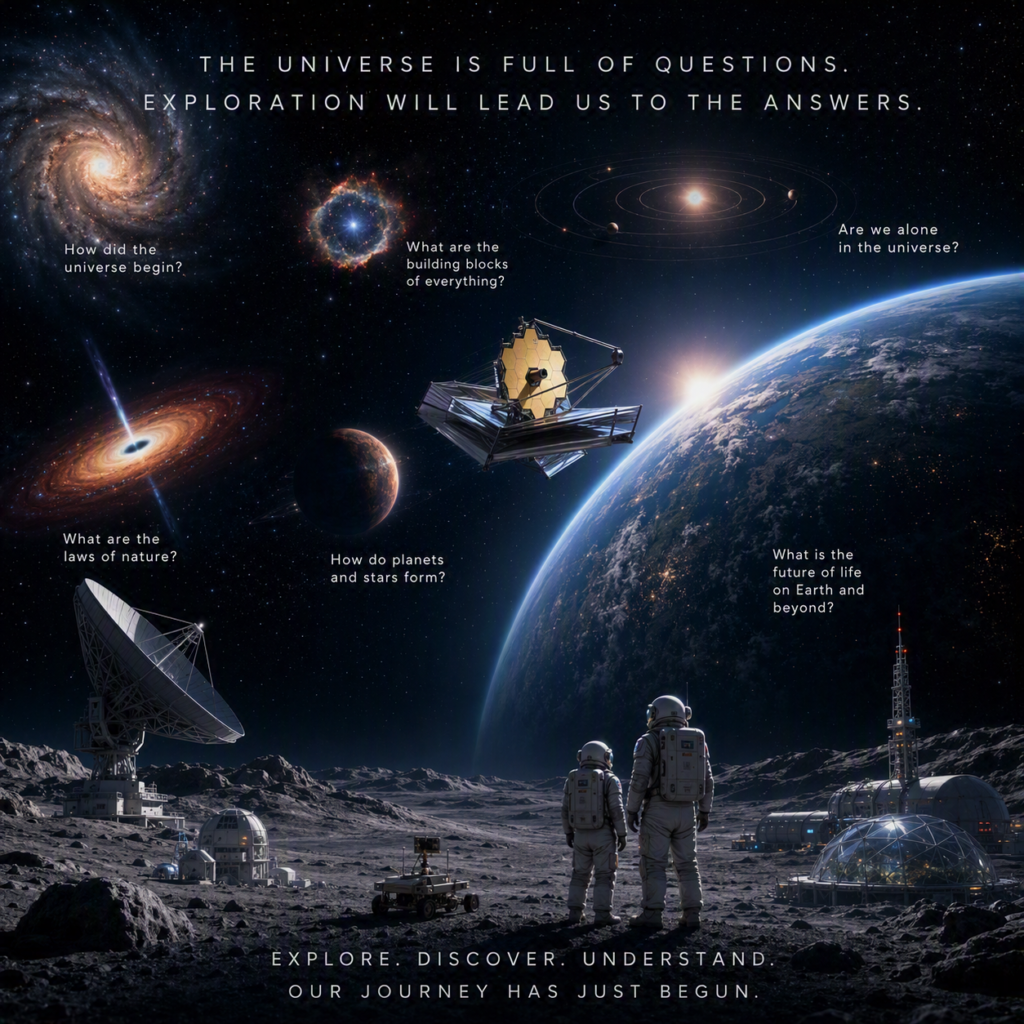
Space exploration is one of humanity’s major instruments of scientific investigation. By freeing itself from atmospheric filters and the Earth’s gravitational pull, it transforms age-old philosophical questions into empirical research programs. This dossier analyzes the contribution of space science to resolving four major questions: the origin of life, the nature of physical laws, the evolution of the Earth, and the fate of consciousness.
1. The origin and prevalence of life in the Universe
1.1. The emergence of life: cosmic imperative or terrestrial anomaly?
The study of life beyond Earth relies on two complementary approaches:
- In situ astrobiology in the Solar System : The observation of liquid water reservoirs beneath the icy crust of moons like Europa (Jupiter) or Enceladus (Saturn) challenges the dogma of a habitable zone restricted to the immediate vicinity of a star. The detection of complex organic molecules in the plumes of Enceladus or in the Jezero crater on Mars indicates that prebiotic chemistry is widespread. If an independent life form (possessing a distinct biochemistry or resulting from local panspermia) were to be characterized on one of these bodies, it would prove that the emergence of life is a deterministic phenomenon once the chemical ingredients and an energy source are present.
- Spectroscopy of exoplanetary atmospheres Analyzing the radiation passing through the atmospheres of exoplanets allows us to search for combinations of gases out of thermodynamic equilibrium (such as the coexistence of carbon dioxide, methane, and oxygen). These atmospheric biosignatures offer a statistical way to assess the frequency of biospheres in the Galaxy.
1.2. The Fermi paradox and the lifespan of civilizations
The absence of detectable signals or artificial infrastructures ( technological signatures ) raises the question of the sustainability of technological civilizations. This cosmic silence fuels the hypothesis of the « Great Filter »: an extremely difficult evolutionary stage to overcome.
Space exploration allows us to assess whether this filter is located upstream (appearance of extremely rare complex life) or downstream ( self-destruction or depletion of resources of technological civilizations).
2. The nature of matter, gravity, and time
2.1. Testing fundamental physics in extreme regimes
Terrestrial laboratories are limited by the local gravitational field and the size of the infrastructure. Space offers a unique experimental environment for testing general relativity and quantum mechanics:
- Space gravitational astronomy : The detection of low-frequency gravitational waves by orbiting laser interferometry allows us to observe the merging of supermassive black holes and to analyze the behavior of gravity in extreme fields, providing observational constraints for quantum gravity.
- The accuracy of equivalence tests : Microgravity experiments allow us to verify the weak equivalence principle with a sensitivity measured at
, thus testing the validity of the standard model and unification theories.
2.2. Mapping the Dark Sector of the Universe
Approximately 1% of the energy content of the Universe consists of dark matter and dark energy, two entities not identified by current particle physics:
- Dark energy : Observing the myriad galaxies with space telescopes measures the acceleration of cosmic expansion over the last billion years in order to determine whether this energy corresponds to the cosmological constant
of general relativity or to a dynamical field.
- Dark matter : Mapping weak gravitational lenses allows us to reconstruct the spatial distribution of invisible matter and to test cold dark matter models against modified gravity theories.
3. The evolution of planetary systems and the fate of the Earth
3.1. Comparative Planetology and Climate Dynamics
The study of the atmospheres and planetary geologies of the Solar System provides essential points of comparison for understanding the history and future of Earth:
| Planetary body | Key characteristic | Teaching for the Earth’s Biosphere |
| Venus | A runaway greenhouse effect ( | Understanding the thresholds of climate tipping points and thermal runaway |
| March | Loss of the magnetosphere and atmospheric erosion | Role of magnetic field and planetary mass in water retention |
| Titan | Low-temperature nitrogen and methane cycle | Model of a reducing atmosphere similar to that of early Earth |
3.2. Prevention of Extinction Risks
Space astronomy catalogs and characterizes near-Earth objects (asteroids and comets). Kinetic deflection missions have demonstrated the possibility of altering the trajectory of a celestial body, transforming a risk of global biological extinction into a manageable engineering problem.
4. The place of consciousness and the human condition
4.1. The Overhang Effect ( Overview) Effect )
Global views of the Earth from space have changed our perception of the biosphere. Direct observation of the thinness of the Earth’s atmosphere and the absence of natural boundaries has historically served as a catalyst for environmental protection movements and the conceptualization of the Earth as a closed and fragile system.
4.2. Humanity as a multi-planetary species
The possibility of establishing a permanent presence on other celestial bodies (such as the Moon or Mars) addresses the question of the long-term survival of human consciousness. By distributing the human species across multiple locations, vulnerability to planetary extinction events (major impacts, pandemics, systemic conflicts) is reduced.
5. Synthesis and epistemological limitations
| Fundamental question | Contribution of space exploration | Epistemological limits |
| What is the origin of life? | Identification of chemical components and suitable environments | Does not resolve the mechanism of the emergence of the initial genetic code |
| Are we alone? | Quantification of habitability and search for biosignatures | The absence of short-range detection does not preclude life at other scales. |
| What is the nature of the Universe? | Measuring the expansion and mapping the dark sector | Depends on the mathematical interpretation of the physical models |
| What is the meaning of existence? | Clarification of the cosmological framework and biological context | A metaphysical and ethical question, outside the empirical realm |
Space exploration provides crucial empirical data for answering scientific questions about our origins, the laws of physics, and the prevalence of life. However, while it sheds light on the how and the material framework of the Universe, it leaves the responsibility of answering the question of meaning to the humanities, philosophy, and ethics .