By Philippe Reclus
summary
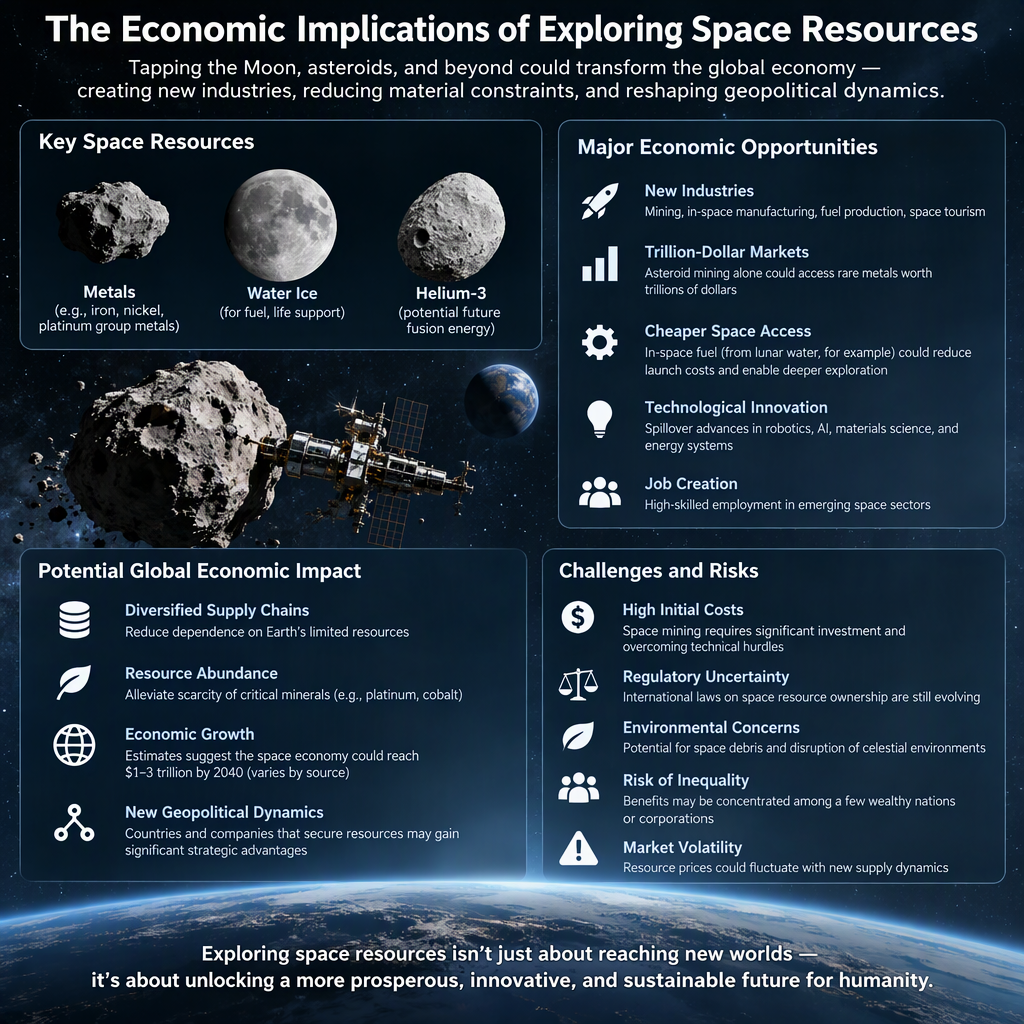
The economic implications of exploring space resources encompass the commercial viability, financial models, and macroeconomic consequences of harvesting extraterrestrial materials, predominantly lunar volatiles and asteroid metals. In the near term, economic interest is centered on in-situ resource utilization (ISRU), particularly the extraction of water ice from permanently shadowed regions of the Moon to produce rocket propellant and life support consumables. Because launching supplies from Earth incurs severe mass penalties and high transportation costs, harvesting propellant within the Moon’s shallower gravity well is projected to outcompete terrestrial alternatives, creating a foundational business case for orbital fuel depots and long-duration space logistics. Over longer horizons, the extraction of asteroid-derived commodities (most notably platinum-group metals (PGMs)) holds significant potential to reshape terrestrial commodity markets. Terrestrial PGM reserves are geographically concentrated and face diminishing returns, escalating capital costs, and substantial environmental burdens. Economic dynamic models indicate that an influx of high-purity, low-cost asteroidal metals could initially expand profit margins before triggering a steep collapse in commodity prices, ultimately establishing a new market equilibrium of material abundance that could stimulate downstream innovations in green technology and hydrogen infrastructure. Despite these prospects, space-resource ventures face formidable financial barriers. Enormous upfront capital expenditures, long payback horizons, high discount rates, and unproven operational lifespans for mining equipment limit near- and medium-term financial viability under conventional capital market valuations. Although venture capital investment into commercial « NewSpace » firms has expanded substantially, commercial ventures currently rely on government anchor tenancy (such as NASA’s Commercial Lunar Payload Services (CLPS) initiative) as the principal financing mechanism to de-risk technologies and sustain market activity. The economic development of off-Earth resources is further constrained by legal and regulatory ambiguity surrounding extraterrestrial property rights. While the 1967 Outer Space Treaty prohibits national appropriation of celestial bodies, several states (including the United States, Luxembourg, the United Arab Emirates, and Japan) have enacted domestic laws granting private property rights over extracted materials, an approach coordinated multilaterally through initiatives like the Artemis Accords. This fragmented legal landscape has generated prominent international controversies regarding geopolitical tensions, the risk of market distortions for mineral-dependent developing economies, and the equitable distribution of economic benefits between spacefaring and non-spacefaring nations.
Characterization of space resources
Space resources identified for potential exploration and utilization primarily consist of volatile deposits (most notably water ice on the Moon) and metallic elements found in asteroids.
Lunar volatiles and regolith
While water and other volatiles are scarce across the inner solar system, direct evidence shows that permanently shadowed regions at the lunar poles contain substantial concentrations of water ice within the regolith. The viability of lunar water extraction is evaluated based on water content benchmarks:
- Studies have shown that when the water content of the regolith exceeds 0.5% by weight, constructing and operating an in-situ propellant generation plant reduces total launch mass compared to supplying missions entirely from Earth, provided there are four or more crewed missions.
- A regolith water content of 1% by weight represents a notable threshold below which in-situ resource utilization (ISRU) is considered unlikely, as equipment mass and power requirements increase significantly between 1% and 2% water content by weight. Extracted lunar water can be utilized directly for human consumption and radiation shielding, or decomposed via electrolysis into oxygen for life support and hydrogen and oxygen for combustible rocket propellant. Due to the Moon’s shallow gravity well, these water-derived products can be exported to fuel depots in lunar orbit or low Earth orbit to support orbital logistics and onward missions. Beyond water ice, the depleted regolith byproduct can also be utilized, such as through sintering, to build operational infrastructure like roads and landing pads.
Asteroid metals
Asteroids are characterized by significant concentrations of both base and precious metals:
- Metallic asteroids consist primarily of iron and nickel, and also contain platinum group metals (PGMs).
- LL Chondrites, an abundant class of near-Earth asteroids, have been identified as containing high-grade concentrations of platinum group metals.
- The metal content in certain types of asteroids is substantial enough that it could potentially replace terrestrial sources of platinum metals entirely.
Economics of in-situ resource utilization
In-situ resource utilization (ISRU) involves extracting and utilizing resources found on celestial bodies, such as the Moon, to support human space activities . International space agencies have identified ISRU as a central area of interest and development, with propellant production regarded as one of its primary applications. Commercial viability in this sector depends on the efficient utilization of local resources, the operational lifespan of mining and processing equipment, and the feasibility of commercial extraction operations.
Launch costs and fuel economics
Supplying missions with propellant launched from the Earth’s surface involves substantial mass penalties and economic costs. For example, delivering 2,100 tons of transit propellant payload to the Earth–Moon Lagrange point 1 (L1) requires an estimated 157,052 tons of launch and transport propellant mass from Earth across multiple launches, resulting in an Earth-propellant-to-delivered-payload ratio of 74.79-to-1. At an estimated propellant cost of $400 per ton, the transport propellant for delivering a single 150-ton load from Earth costs $4.49 million, valuing one ton of Earth propellant delivered to L1 at approximately $30,000 based on delivery propellant costs alone. Transporting transit propellant from Earth for a single Mars expedition fleet would total approximately $63 million in propellant costs, representing $628,000 per person for an expedition of 100 passengers. Because of gravitational potential and the additional velocity gained from executing an Oberth maneuver starting from a high orbit or Lagrange point, propellant positioned at L1 is considered at least twice as valuable as propellant situated in low Earth orbit (LEO).
Commercial viability of lunar resources
By harvesting local resources, ISRU can bypass the high cost of launching supplies out of Earth’s gravity well. Establishing a business case for the extraction of lunar water is considered a foundational step for bootstrapping an off-Earth economy alongside robotics and 3D printing. Economic models demonstrate that lunar-derived rocket propellant can outcompete propellant launched from Earth, even when factoring in projections where Earth launch costs decline as far as possible. Technical approaches for extracting water from lunar regolith include heating via low-power microwaves and tent sublimation methods. In performance evaluations where an advantage threshold metric () of 35 or greater indicates that lunar propellant is more cost-effective than Earth-supplied propellant, tent sublimation technologies have been estimated to achieve values exceeding 400. However, realizing this economic advantage remains contingent on proving the commercial viability, equipment operating life, reliability, and technology readiness levels (TRL) of ice mining and processing technologies.
Terrestrial commodity market implications
The introduction of extraterrestrial resources has significant implications for global commodity markets, particularly for platinum-group metals (PGMs) such as platinum, palladium, rhodium, and iridium. The terrestrial PGM market is historically susceptible to supply disruptions. Terrestrial reserves are heavily concentrated in South Africa and Russia, where demand has frequently outpaced supply.
Terrestrial extraction constraints
Terrestrial PGM extraction faces diminishing returns and escalating operational challenges. As existing terrestrial mine shafts reach greater depths, the energy and capital requirements for reefing, power, and refrigeration increase exponentially. This development has been described as a geological and economic « event horizon, » where extraction costs threaten to exceed market values. Despite high market prices driven by supply–demand imbalances, terrestrial mining operations experience compressed gross margins in the single digits, with an estimated 25% of producers operating at negative margins below certain spot prices. By contrast, the potential influx of low-cost extraterrestrial materials presents a competitive dynamic that could displace high- and medium-cost terrestrial suppliers over time.
Market dynamics and price collapse projections
Economic modeling suggests that extraterrestrial PGMs could enter commercial markets within a 20-year horizon, though ventures face high upfront operational costs and demand uncertainties. Projections indicate that the transition from terrestrial to space-based mining could unfold over approximately 15 years, during which space-sourced metals progressively replace terrestrial supply. System dynamics models evaluate this shift through several stages:
- Initial margin expansion: In the early stages of market penetration, commodity prices are anticipated to remain relatively steady while the lower cost of asteroidal supply reduces overall production costs to less than a quarter of terrestrial levels. This could temporarily inflate industry profits-one model estimates an increase from $2.4 billion to $19.2 billion annually.
- Price collapse and stabilization: As space-based extraction expands to meet almost all global demand, market clearing prices are projected to fall steeply. For example, baseline models suggest prices could drop to approximately $11,000 per kilogram, causing aggregate market profits to contract unless offset by expanding demand.
- New market equilibrium: Rather than representing a structural market failure, this price collapse reflects an evolution toward abundance. Prices are expected to stabilize at a new steady state where industry gross margins normalize to standard levels of approximately 10%. While demand for PGMs has historically been relatively inelastic in the short term, substantial price reductions are expected to spur elasticity and aggregate market growth.
Downstream industrial and environmental effects
The abundance of low-cost, high-purity space resources is projected to catalyze downstream industrial development. Readily available PGMs could spur innovation in advanced materials science, energy storage, catalysis, and green technologies, particularly automotive catalytic converters and hydrogen energy infrastructure. Furthermore, the displacement of terrestrial mining by automated extraterrestrial operations offers environmental and social dividends. Terrestrial extraction causes severe local ecological degradation, including acid mine drainage, water table contamination from lead and arsenic, and conflicts over land use and tailings dams. Shifting extraction off-planet circumvents local « not in my backyard » (NIMBY) opposition and reduces global reliance on hazardous deep-shaft and artisanal mining operations that are frequently associated with human rights abuses.
Investment dynamics and financing mechanisms
Venture capital and private equity
Venture capital has functioned as a transformative force in the space industry, driving down costs and fostering innovation. The traditional venture capital model relies on a positive feedback loop: investing long-term capital, supporting portfolio companies across years of growth, returning proceeds, and reinvesting capital into new ventures. From 2000 onward, venture capital investments in start-up space ventures reached $12.5 billion, with 91% of that total invested in a five-year span. The deployment of venture capital into startups operating within the emerging « new » space economy has expanded internationally, including across European nations, with longstanding databases tracking these investments into portfolio companies regardless of the eventual investment outcome.
Capital market valuation and financial viability
From the perspective of conventional capital markets, space-resource ventures face distinct financial hurdles. Projects are characterized by enormous upfront capital requirements, extended payback periods, and high discount rates, all of which weigh on their financial attractiveness. Consequently, analytical models indicate that technological feasibility does not necessarily translate into financial viability; under moderate economic scenarios, ventures such as asteroid mining are considered unlikely to be financially viable in the near or medium term when evaluated under traditional capital-market valuation frameworks. To evaluate these opportunities, economic models employ the real options framework borrowed from mining and natural resource finance to analyze how specific conditions and uncertainties dictate the timing of private capital deployment.
Legal uncertainty and property rights regimes
The timing and scale of private investment in space resources are heavily influenced by the legal and regulatory environment. A fundamental barrier identified in commercial space investment is that the absence of exclusionary rights or private property regimes can actively deter private capital. Investors navigate legal uncertainty spanning the future authorization, permissibility, ownership, commercialization, liability, and international recognition of space-resource extraction. This regulatory environment remains fragmented:
- Several states have enacted unilateral domestic legal frameworks to govern property rights and space resources, including the United States, Luxembourg, the United Arab Emirates, and Japan.
- Multilateral efforts proceed concurrently, such as the United Nations Committee on the Peaceful Uses of Outer Space (COPUOS) Legal Subcommittee Working Group on Legal Aspects of Space Resource Activities, which seeks to develop nonbinding recommended principles.
- Other legal models, such as the United Nations Convention on the Law of the Sea (UNCLOS) framework for deep seabed exploitation, incorporate equitable financial distribution schemes and tiered production payments to international bodies, alongside capacity-building and technology-sharing mechanisms for non-spacefaring or developing states. Despite the absence of a definitive international legal resolution, factors such as declining launch costs, technological progress, and first-mover incentives continue to drive private investment into in-situ resource utilization (ISRU) and related extraction capabilities, with policy frameworks often advocating that private investors bear the commercial risk.
Government anchor tenancy and public contracting
Due to the absence of a deep, self-sustaining pool of private customers willing to finance off-world exploration independently, government contracts serve as a primary financing mechanism that pulls the market forward. Public agencies frequently act as anchor customers to de-risk commercial space ventures. A prominent example is NASA’s Commercial Lunar Payload Services (CLPS) initiative, a contracting vehicle with a maximum potential value of $2.6 billion through 2028 covering 17 contracted deliveries. Through this model, public contracts fund missions while private contractors own and operate the vehicles, retaining the ability to commercialize and sell remaining payload space to universities, foreign space agencies, and private entities. Public commitments under this program include nearly $600 million awarded across vendors such as Astrobotic (approximately $298 million for two deliveries), Firefly Aerospace (roughly $144 million), and Intuitive Machines (about $148 million). Although commercial firms operate the infrastructure, public procurement remains the central mechanism sustaining the early lunar and space resource services market.
Legal, regulatory, and property rights economics
At its fundamental level, property involves legal relations regarding the control and disposition of valued resources. In outer space, the economic viability of commercial resource exploration and mining relies heavily on regulatory clarity. The establishment of secure property rights fosters investor confidence, whereas legal ambiguity creates significant economic uncertainty regarding commercial rights to extracted resources. Consequently, investors often view state regulatory oversight and clear domestic frameworks as essential signals of stability and risk mitigation.
The non-appropriation principle and national legislation
The economic governance of space resources faces competing legal interpretations under international space law. Article II of the Outer Space Treaty establishes the « non-appropriation » principle, stipulating that outer space (including the Moon and other celestial bodies) is not subject to national appropriation by claim of sovereignty, use, occupation, or other means, in order to keep space accessible to all. The degree to which domestic laws granting private property rights over extracted space materials align with this international principle has generated extensive debate and legal analysis. To incentivize commercial investment and space mining, four nations have enacted domestic legislation recognizing private ownership rights over extracted space resources:
- United States: Enacted the Commercial Space Launch Competitiveness Act of 2015 (which includes the Space Resource Exploration and Utilization Act), granting U.S. citizens and commercial entities the legal right to possess, own, and sell resources commercially obtained in outer space in accordance with international obligations.
- Luxembourg: Passed the 2017 Law on the Exploration and Use of Space Resources, which explicitly establishes that space resources are capable of being appropriated.
- United Arab Emirates: Introduced Federal Law No. 12 of 2019 on the Regulation of the Space Sector, recognizing private rights to extracted resources.
- Japan: Enacted the Space Resources Act in 2021, building on its 2008 Basic Space Law and 2016 Act on Launching of Spacecraft. Under this system, Japanese private operators licensed by the Prime Minister can engage in the exploration and development of non-living resources (such as minerals and lunar water ice (which can be processed into hydrogen and oxygen propellant)) and obtain legal ownership of them.
Multilateral frameworks and international coordination
Beyond domestic legislation, international norms surrounding space resource economics are increasingly coordinated through multilateral agreements such as the U.S.-led Artemis Accords. Established in October 2020 alongside early signatories such as Japan, Luxembourg, the UAE, Canada, Australia, Italy, and the UK, the Accords establish guidelines for safe and transparent exploration, deconfliction of activities, and the extraction of space resources in compliance with the Outer Space Treaty. Although dozens of nations have signed the Accords, key space-faring nations including China and Russia have remained outside the framework. Additionally, legal discourse continues regarding the « common benefit » and equitable sharing principles under international treaties, with debates over how economic benefits derived from space exploration should be shared among spacefaring and non-spacefaring nations, as well as developing countries.
Intellectual property and enforcement challenges
Significant regulatory and economic gaps persist in the protection and enforcement of intellectual property (IP) rights in space. While some nations, such as the United States, have enacted legislation addressing patent rights for inventions made, used, or sold in space, an international consensus is lacking, and clear rules governing inventions made or used on the Moon do not exist. Furthermore, commercial entities face practical hurdles in monitoring and enforcing IP protections for space-based manufacturing, particularly for assets, processes, and products that never return to Earth. The lack of a harmonized international regime leaves open risks for supply-chain disputes and unaddressed commercial liabilities in off-Earth economic activity.
Macroeconomic growth and long-term outlook
Technological advances, declining operational costs, and expanding capital investment have transformed space-based resource extraction and utilization from theoretical concepts into viable economic activities. The emergence of the commercial « NewSpace » sector is anticipated to generate a multi-billion-dollar market spanning manufacturing in orbit, lunar services, orbital logistics, and off-world resource exploitation.
Investment dynamics and market expansion
Historically, the broader space economy has been anchored in terrestrial and orbital infrastructure. In 2025, ground equipment accounted for approximately $165 billion in revenue and satellite services generated $105 billion, whereas commercial launch accounted for roughly $12.4 billion. However, long-term projections point toward rapid diversification into emerging commercial sectors. For instance, the global in-orbit servicing market is projected to expand from $2.4 billion in 2026 to $9.8 billion by 2036, representing a compound annual growth rate of 15.1%. Capital inflows into these frontier sectors are heavily influenced by the legal and institutional environment. The establishment of stable, predictable regulatory regimes and defined property rights facilitates private investment into space innovation and resource utilization. Research demonstrates a statistically meaningful increase in investment within a nation’s space economy following its enactment of domestic space property rights. Because the scale of capital required to extract extraterrestrial value remains substantial, property frameworks also incentivize the formation of well-funded multinational coalitions and private enterprise partnerships.
Shifts in terrestrial commodity markets
The prospective extraction of off-world materials (particularly critical and precious commodities) presents profound macroeconomic implications for global commodity pricing and trade flows. Economic models analyzing long-term supply dynamics, such as stock-and-flow simulations of platinum group metals (PGMs), illustrate how asteroid mining could restructure resource markets. Terrestrial PGM extraction is divided largely between medium-cost reserves, predominantly located in South Africa and Russia, and higher-cost extraction located elsewhere, such as in the United States. Asteroid mining entities (such as AstroForge) represent a potential low-cost supply stock. Driven by market incentives to maximize gross margins, an expanding off-world low-cost supply capacity could gradually displace terrestrial medium- and high-cost producers, placing downward pressure on global mineral prices over the long term.
Global disparities and distribution of benefits
While resource extraction offers macroeconomic growth opportunities, it presents challenges regarding international economic inequality. The establishment of space-resource industries on a first-come, first-served basis risks widening the economic gap between technologically and financially capable spacefaring nations and non-spacefaring developing nations. A major concern is the exposure of developing economies that rely heavily on terrestrial mineral exports to adverse price shocks and export revenue declines caused by extraterrestrial production. To counter these imbalances, international discourse has addressed mechanisms for sharing the benefits of space exploitation. Proposed measures include establishing capacity-building programs, transferring expertise and technology to non-spacefaring states, and providing compensatory support policies to offset terrestrial export disruptions. Bilateral and multilateral frameworks, such as the Artemis Accords, seek to coordinate resource-extraction activities and commit signatories to public sharing of scientific data, although geopolitical tensions continue to present obstacles to a fully harmonized global governance regime.