By Philippe Reclus
Summary
This thesis examines the extent to which space exploration can shed light on the origin of life. Its central argument is that it will probably not identify a single original event, but that it can test the conditions, ingredients and processes that can lead from prebiotic chemistry to biology. The study links laboratory experiments, geological archives, meteorite and asteroid samples, missions to Mars and icy moons, as well as the observation of exoplanets. It compares the main hypotheses of abiogenesis and distinguishes them from panspermia, which concerns the transport of living or prebiotic matter rather than its initial appearance. Space exploration thus appears to be a way to compare several natural environments and to determine whether the conditions associated with life on Earth are common, rare or insufficient. The conclusion remains conservative, however: biosignatures are often indirect and can also result from abiotic processes.
Introduction
The origin of life remains difficult to reconstruct, because terrestrial geological activity has erased a large part of the oldest archives. Space exploration offers a complementary path: it makes it possible to study celestial bodies that have preserved primitive materials or environments comparable to those of the ancient Earth. The guiding question of this thesis is therefore the following: can the study of space reveal the processes that made the transition from non-living matter to life possible? The hypothesis is that no isolated observation will suffice, but that the comparison of several lines of evidence can constrain plausible scenarios. The thesis first presents the main theories of abiogenesis and panspermia, then examines the contributions of interstellar molecules, small bodies in the Solar System, Mars, icy moons and exoplanets. Finally, it evaluates the limits of biosignatures and the technologies needed to strengthen the conclusions.
Historical perspectives
Ideas about life beyond Earth have moved from philosophical speculation to experimental inquiry. Ancient thinkers already imagined a plurality of worlds, but they had no way to test this possibility. Modern astronomy has gradually made it possible to characterize planets, while twentieth-century advances in chemistry, molecular biology, and geology have made it possible to study the conditions under which life emerges. Astrobiology was born out of this convergence: it does not only look for extraterrestrial organisms, but compares environments, molecules, and processes that could lead to life. This shift from speculation to testable hypotheses justifies the central role of space exploration in current research.
To assess the significance of these observations, three criteria will guide the comparison. First, evidence must establish the presence of ingredients or conditions compatible with prebiotic chemistry. Second, it must make it possible to distinguish biological and abiotic mechanisms as much as possible. Third, it must be able to be compared with other observations or reproduced by sample analysis and experimentation. This grid avoids confusing habitability, organic chemistry and proof of life.
Theories of abiogenesis
Abiogenesis refers to the emergence of living systems from non-living matter. The main models do not all explain the same step in the process. The primordial soup hypothesis focuses on the accumulation and transformation of organic molecules in aqueous media. Hydrothermal scenarios emphasize energy gradients and mineral compartments capable of sustaining chemical reactions. Catalysis on mineral surfaces proposes that certain minerals concentrated the reactants and promoted their assembly. The RNA world, on the other hand, seeks to explain how a molecule could have both stored information and catalyzed reactions before the appearance of modern cells. Space exploration can test these models by looking for their ingredients, environments, and chemicals on other worlds.
Panspermia hypothesis
Panspermia proposes that organisms, or more cautiously certain prebiotic materials, can be transported from one world to another. It therefore does not solve the ultimate origin of life: it shifts the question to the place where this life or chemistry would have appeared. The natural exchange of rocks between planets shows that the interplanetary transport of matter is possible. However, it does not demonstrate the survival of organisms during ejection, travel and impact, nor the establishment of life in a new environment. This hypothesis nevertheless remains relevant, because it leads to the study of the resistance of molecules and organisms as well as the possible links between the organic inventories of different stars.
Organic molecules in space
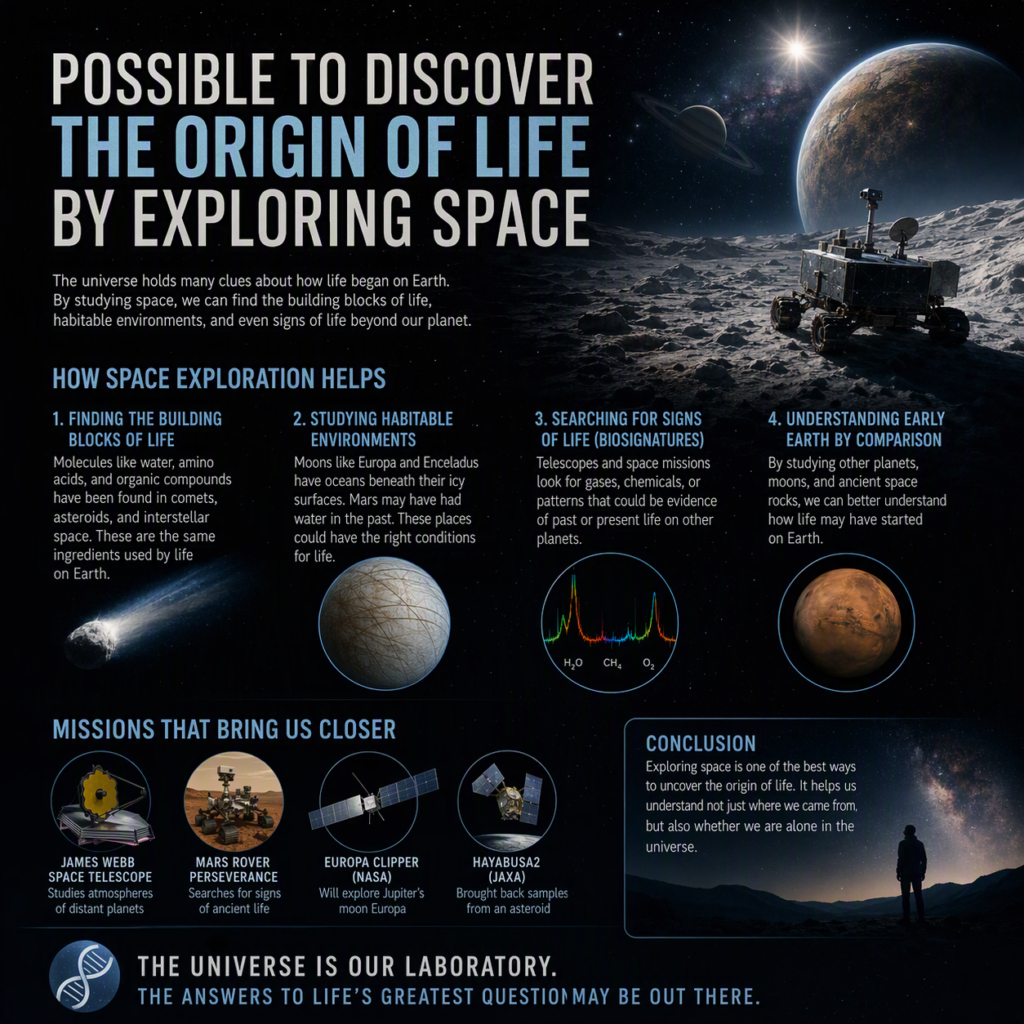
Radio telescopes and space probes have identified many carbonaceous molecules in interstellar clouds and other extraterrestrial environments. The presence of alcohols, amino acids and complex organic compounds shows that certain chemical building blocks associated with life can form without biological intervention. However, it does not constitute proof of life or even a demonstration that abiogenesis is underway. Rather, its importance lies in the fact that the chemistry required for prebiotic scenarios is not limited to Earth and that already complex materials can be incorporated into forming planetary systems.
Meteorites and asteroids
Carbonaceous meteorites contain amino acids and other organic compounds formed without biological activity. Asteroid samples make it possible to study these molecules in a material that is less altered by the Earth’s atmosphere and environment. These data provide information on the chemical inventory of the early Solar System and on the substances that could have been delivered to the young Earth. They do not prove that this contribution triggered the emergence of life, but they do make it possible to assess whether some of the necessary raw materials were available beyond our planet.
Comets and Water Delivery
Comets preserve some of the primitive matter from the formation of the Solar System. Their ice and organic compounds make them witnesses of the chemical resources available before and during the formation of planets. They may have contributed to the supply of water and organic matter to the young Earth, without this contribution necessarily being unique or dominant. Comparing their composition to that of Earth’s reservoirs therefore makes it possible to test the extent of this contribution and to better reconstruct the chemical conditions prior to the appearance of life.
Mars and ancient habitability
Mars once had rivers, lakes, and sedimentary environments that may have been habitable. Rovers are looking for minerals, sedimentary structures, and chemical patterns that can reconstruct these ancient environments, as well as possible biosignatures. Evidence of habitability would show that water, energy, and some chemical elements were brought together; it would not demonstrate that life arose. Establishing a biological origin would require identifying a set of consistent signatures and ruling out geological processes capable of producing similar clues.
Europa and Enceladus
Europa and Enceladus probably harbor oceans beneath their icy crusts. Liquid water, possible sources of energy, and the presence of chemical compounds make them major targets for the study of habitability. Their interest in the origin of life is comparative: if complex chemistry or biosignatures were to appear in oceans isolated from the surface, it would show that environments very different from Earth can support prebiotic or biological steps. The absence of such clues would instead require re-examination of what additional conditions are needed.
Exoplanets and biosignatures
Thousands of exoplanets have been discovered, making it possible to compare a diversity of worlds far greater than that of the Solar System alone. Spectroscopy can reveal certain atmospheric constituents, including oxygen and methane, as well as states of chemical imbalance. None of these clues prove the presence of life in isolation, as abiotic processes can also produce them. Their interpretation requires taking into account the star, temperature, geology and the full combination of gases observed. Exoplanets thus contribute to the question of the origin of life by showing the extent to which the conditions associated with the Earth are common or exceptional.
Scientific limitations and challenges
The main difficulty is not only to detect a signal, but to establish its origin. A molecule, structure or chemical imbalance may be the result of a biological process or geological mechanism that is still poorly understood. Terrestrial contamination can also produce false positives, while small sample sizes limit their representativeness. Remote measurements add instrumental uncertainties and depend on interpretation models. A robust conclusion therefore requires several independent indices, contamination checks, reproducible analyses and an explicit comparison with abiotic explanations. These requirements explain why a spectacular discovery must remain provisional until it has been confirmed by other methods.
Technologies of the future
Future advances will depend on technologies that can reduce current ambiguities. More sensitive telescopes will be able to analyze the atmospheres of smaller exoplanets and compare multiple gases in context. Sample return missions will allow more precise instruments to be used on Earth and analyses to be repeated. Laboratories will be able to test abiotic mechanisms that can mimic biosignatures and replicate steps in prebiotic chemistry. Artificial intelligence can help spot complex patterns in large datasets, but its results will need to remain interpretable and verifiable. Together, these tools can enhance the convergence of evidence without removing the need for rigorous controls.
Conclusion
Space exploration may never reveal the precise moment when life began, but it can greatly reduce the field of plausible explanations. Meteorites, asteroids, and comets provide information about the ingredients available in the early Solar System; Mars and icy moons offer natural laboratories for studying habitability and prebiotic chemistry; exoplanets make it possible to test whether certain atmospheric signatures are found on a cosmic scale. None of this evidence is sufficient in isolation, because an organic molecule, a habitable environment, or a chemical imbalance does not automatically constitute evidence of life. Their convergence can nevertheless show which processes are frequent and which appear exceptional. The answer to the question posed is therefore conditional: exploring space can shed light on the origin of life, not by replacing the study of Earth, but by providing the necessary comparisons to distinguish between the possible, the probable, and the truly biological. The discovery of life that appeared independently elsewhere would transform this investigation by demonstrating that the emergence of life is not an exclusively terrestrial event.