By Philippe Reclus
An idea came to me last night on my terrace while stargazing: What if?
Idea
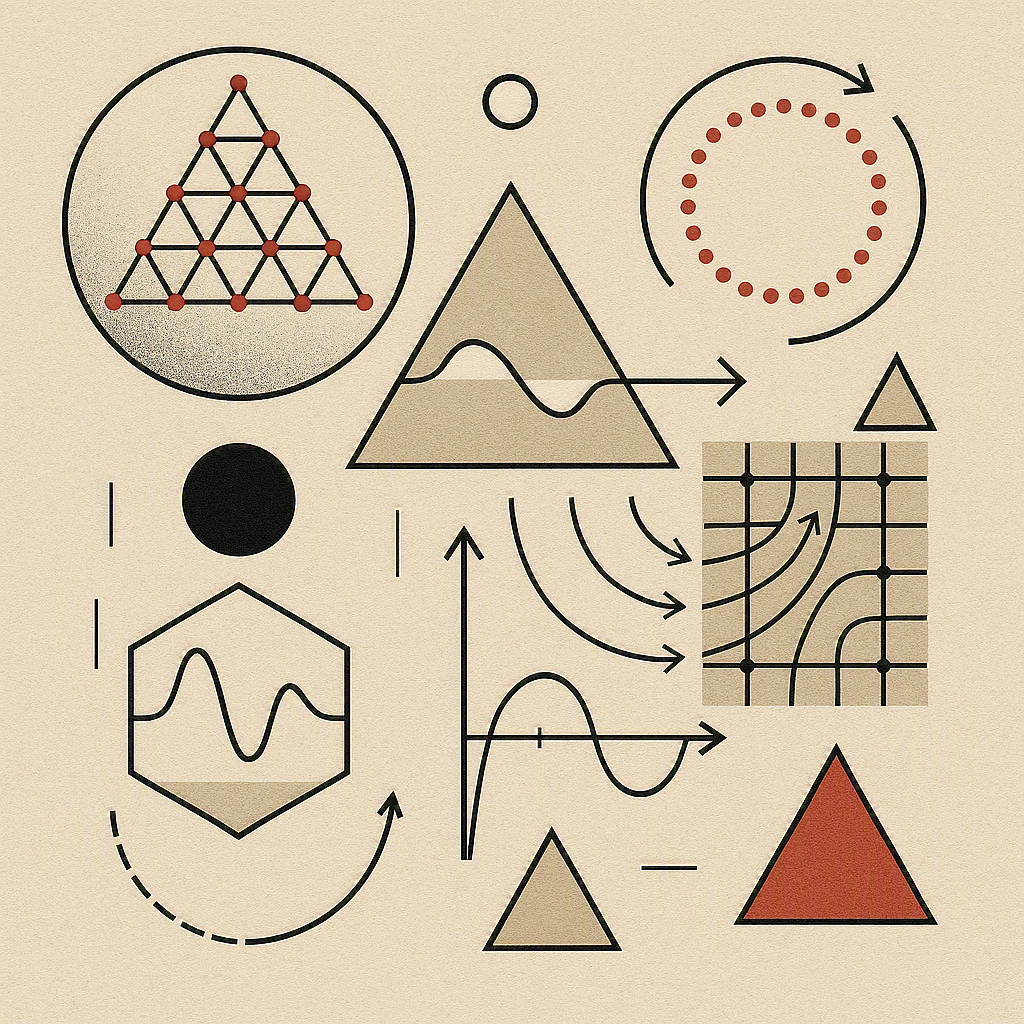
What if certain structures of matter existed in a state of geometric memory: not a chemical memory, but a memory inscribed in the very form of physical fields, capable of persisting and influencing future events on a very small scale?
Development
The idea would be that, in certain complex systems, fields do more than simply transport energy or information: they would retain a stable record of their past interactions in the form of invisible geometric patterns, a bit like a topological scar.
This memory would not be magical. It would only act under extreme conditions:
• in the vicinity of phase transitions,
• in highly disordered environments,
• or at the quantum scale, in networks of strongly correlated particles.
Testable Prediction
If this idea is true, then two physically identical systems that have followed different evolutionary paths could produce slightly different results, even after the apparent equalization of their global parameters.
In other words, the system’s history would not be completely erased by its final state.
Possible Experiment
This could be tested with:
• a network of superconducting or magnetic materials,
• subjected to different excitation sequences,
• then returned to the same measurable final state.
If the subsequent responses remain distinct beyond experimental noise, this would suggest a trajectory memory stored in the system’s structure.
Scientific Significance
Such a discovery would change three things:
• how we understand irreversibility,
• the boundary between state and history in physics,
• and perhaps certain mechanisms of life, where the shape of the environment is as important as its composition.
This project examines the hypothesis that certain complex physical systems retain a measurable trace of their evolutionary trajectory, even when reduced to identical state parameters. The objective is to determine whether two systems prepared in the same final state, but obtained via different dynamic paths, exhibit statistically distinct subsequent responses. This difference would be interpreted as a geometric memory or trajectory memory. The study aims to distinguish a simple incomplete relaxation effect from a deeper structural phenomenon related to field organization, defects, or internal correlations.
Problem Statement
In classical statistical physics, it is assumed that a given macroscopic state summarizes the relevant information about a system at equilibrium. However, in many non-equilibrium systems, the final state can depend on the path taken to reach it. The central question is: does a lasting trajectory memory exist in certain physical media that is not reducible to standard state variables?
Research Hypothesis
The hypothesis is that certain systems, particularly those with strong correlation, nonlinear dynamics, or near phase transitions, can store information about their history as stable geometric structures in state space. This memory would be neither psychological nor metaphorical, but a physical property observable through differential responses to identical perturbations.
Objectives
1. To detect experimental signatures of path dependence.
2. To distinguish this dependence from classical effects of transient memory, hysteresis, or slow relaxation.
3. To identify the physical conditions that enhance or erase this memory.
4. To propose a minimal theoretical framework capable of linking trajectory, internal structure, and future response.
Theoretical Framework
This project lies at the interface of non-equilibrium systems physics, phase theory, and complex media physics. The system will be formulated not only by its instantaneous state, but also by topological or geometric descriptors of its trajectory in parameter space. The idea is that a particular temporal evolution could modify the accessible structure of the system, leaving a trace in its internal correlations or persistent defects.
Methodology
1. Choice of Model Systems
Three families of systems will be prioritized:
• disordered magnetic networks,
• superconducting materials or active colloids,
• simulated nonlinear network-type systems with controlled noise.
2. Experimental Design
Two protocols will be applied to the same system:
• Protocol A: monotonic rise and fall of a control parameter.
• Protocol B: a different sequence leading to the same measured final state.
Both samples will then be subjected to an identical perturbation. The measured responses will be compared.
3. Observed Variables
• susceptibility,
• relaxation time,
• spectrum of fluctuations,
• spatial correlations,
• stability of the response after partial reset.
4. Evaluation Criteria
We will look for:
• reproducible differences between A and B,
• persistence of these differences after correction of trivial variables,
• systematic dependence on the geometry of the trajectory.
Experimental Controls
To avoid misinterpretation, several controls will be necessary:
• verification that the two final states are identical according to standard observables,
• repetitions on several samples,
• control of thermal and instrumental noise,
• comparison with systems known to exhibit simple hysteresis,
• partial reversibility tests to measure the proportion of memory actually retained.
Experienced Results
Three scenarios are considered:
1. No effect: the path dependence disappears once the final state is strictly equalized.
2. Classical effect: the observed difference is explained by incomplete relaxation or residual defects.
3. Robust effect: a difference persists despite controls, suggesting a deeper trajectory memory.
The third scenario would constitute a major conceptual advance, as it would imply that the state of a system is not always sufficient to predict its future response.
Scientific implications
If the hypothesis is validated, it could change the way we think about:
• irreversibility,
• the notion of state in complex physics,
• information storage in matter,
• and certain robustness mechanisms in biological systems or self-organizing materials.
Limitations
This project is speculative and carries several risks:
• confusion with known hysteresis effects,
• difficulty in defining a truly identical final state,
• extreme sensitivity to noise,
• ambiguous interpretation of the observed correlations. This is why methodological caution is essential: the initial hypothesis must remain falsifiable and not assume the existence of the phenomenon in advance.
Conclusion
This project explores a simple yet radical idea: the history of a system could leave a measurable physical trace beyond its usual state parameters. If such an effect exists, it would open up a new way of understanding memory in matter and the dynamics of complex systems.
Scientists, get to work!