
By Philippe RECLUS
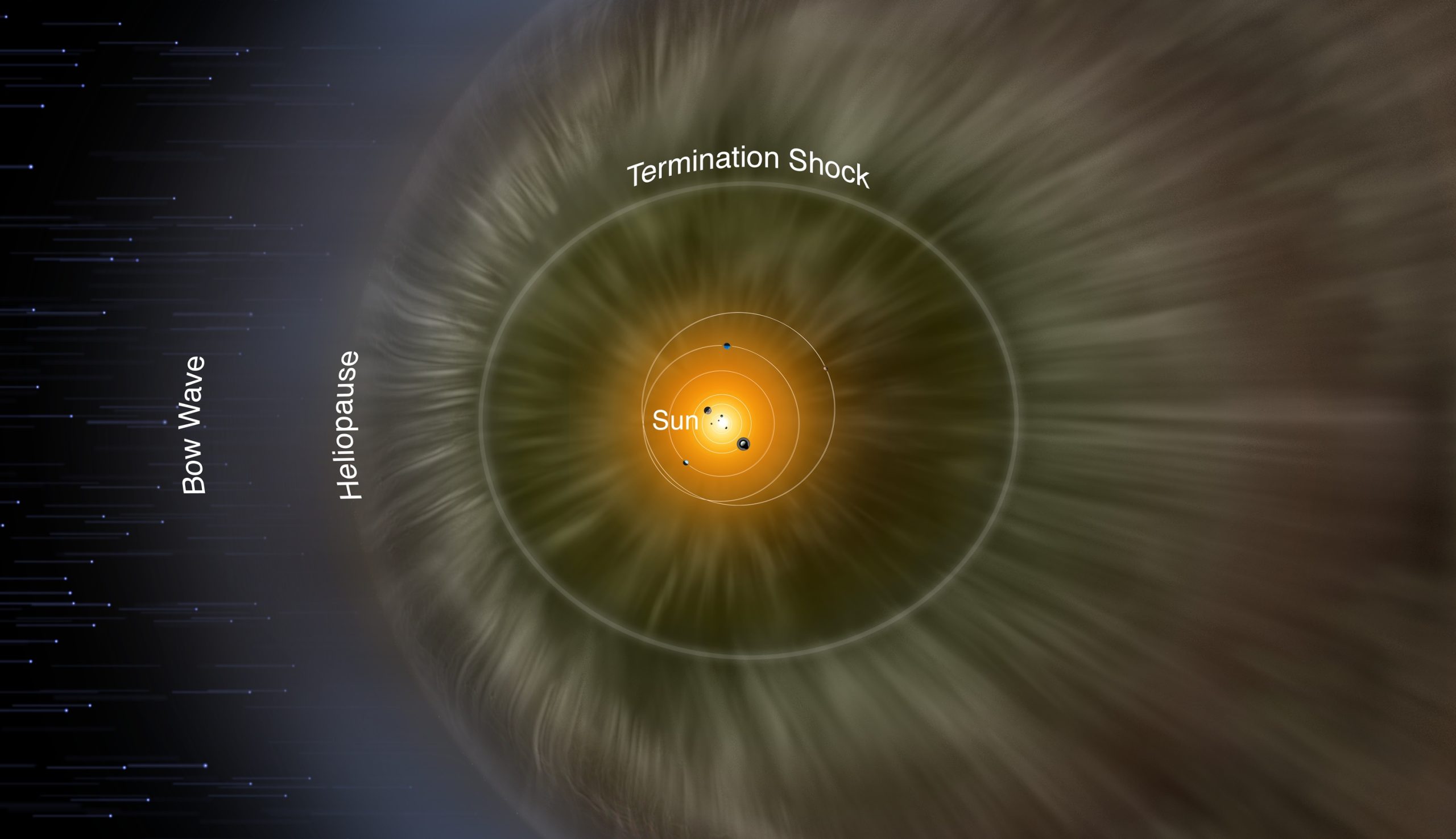
The Heliosphere: A protective bubble around our solar system
The heliosphere, a vast bubble-shaped gaseous envelope, constitutes the immediate spatial environment of our solar system. It extends over APPROXIMATELY 20 billion kilometers, well beyond the orbit of Neptune, and encompasses all the planets, moons and asteroids that orbit the Sun.
This region, shaped by solar winds and the Sun’s magnetic field, acts as a protective shield against harmful radiation coming from the interstellar medium.
Formation and structure of the heliosphere
The Sun, through its intense activity, produces a continuous flow of charged particles, called solar wind. This solar wind, composed mainly of electrons and ions, escapes from the Sun at speeds of up to 2 million kilometers per hour.
As it moves away from the Sun, the solar wind encounters the interstellar medium, a thin and diffuse gas that fills the space between the stars. The collision between these two environments creates a boundary, the heliopause, which marks the limit of the Sun’s influence.
The heliosphere is not a perfect sphere, but rather a bubble-like envelope, the shape of which is distorted by the solar wind and the interstellar magnetic field. The size and shape of the heliosphere also varies depending on the solar cycle, which corresponds to a period of solar activity of approximately 11 years.
The different layers of the heliosphere
There are several distinct zones within the heliosphere, each with its own characteristics:
• The magnetospheric zone: Directly surrounding the Sun, this zone is dominated by the intense solar magnetic field. It traps charged particles from the solar wind, creating spectacular phenomena such as the Northern and Southern Lights.
• The solar wind: Extending beyond the magnetospheric zone, the solar wind weakens and becomes rarer. It is in this area that we find most of the planets in our solar system.
• The transition layer: This region marks the transition between the solar wind and the interstellar medium. It is characterized by increased turbulence and the presence of complex structures formed by the interaction of the solar wind with the interstellar magnetic field.
• The heliopause: Ultimate boundary of the heliosphere, the heliopause marks the limit of the influence of the solar wind. Beyond that, we find the interstellar medium, a hostile environment for life as we know it.
The importance of the heliosphere for life on Earth
The heliosphere plays a crucial role in protecting life on Earth. Indeed, the Earth’s magnetic field, although much weaker than that of the Sun, acts like a miniature shield, deflecting harmful charged particles from the solar wind. Without the heliosphere, this radiation would bombard the Earth’s surface, causing devastating effects on the atmosphere and life itself.
The study of the heliosphere is essential to better understand our place in the universe and to anticipate the potential dangers linked to extreme solar events. Space probes, such as Voyager 1 and 2, which explore the far reaches of the heliosphere, provide us with valuable information about this distant and mysterious environment.
The heliosphere, although sometimes invisible to our eyes, is an essential component of our solar system, which plays a vital role in protecting our planet and the life on it.